게임 관련 정보
How to Evaluate Weapons
When choosing weapons, it is easy to focus on familiar numbers: damage, range, and reload time.
However, in actual combat, victory is often determined by entirely different characteristics: flight trajectories, initial speed, and interaction with air defense systems.
In this article, we will look at what else you should pay attention to and how to choose weapons that truly suit your playstyle and the specific task at hand.
Power Usually Comes at a Price
Most weapons in Modern Warships are built around trade-offs. If one parameter is noticeably above average, the weapon will often be weaker in another area.
For example:
- A missile with high damage and long range often flies at a higher altitude or accelerates more slowly after launch. The higher and more predictable its trajectory, the longer the missile remains within the engagement zone of enemy air defenses and the easier it is to intercept. Low-flying, or “sea-skimming,” missiles pass through the danger zone more quickly and generally have a better chance of penetrating air defenses. However, the trade-off may be lower damage, shorter range, or weaker performance in other areas.
- A cannon with high salvo damage often has a long reload time. A rapid-fire gun, on the other hand, fires more frequently but deals less damage per shot.
This is why a high number in one stat tells only half the story. It is important to understand what the weapon sacrifices in exchange for that advantage.
Why Similar Weapons Perform Differently
Two weapons can have almost identical damage, range, and reload values yet perform very differently in combat. For example, one missile may consistently reach its target while another is intercepted much more often.
The following parameters are worth paying attention to:
- flight altitude;
- initial speed;
- acceleration time.
These characteristics determine whether enemy air defenses have enough time to react.
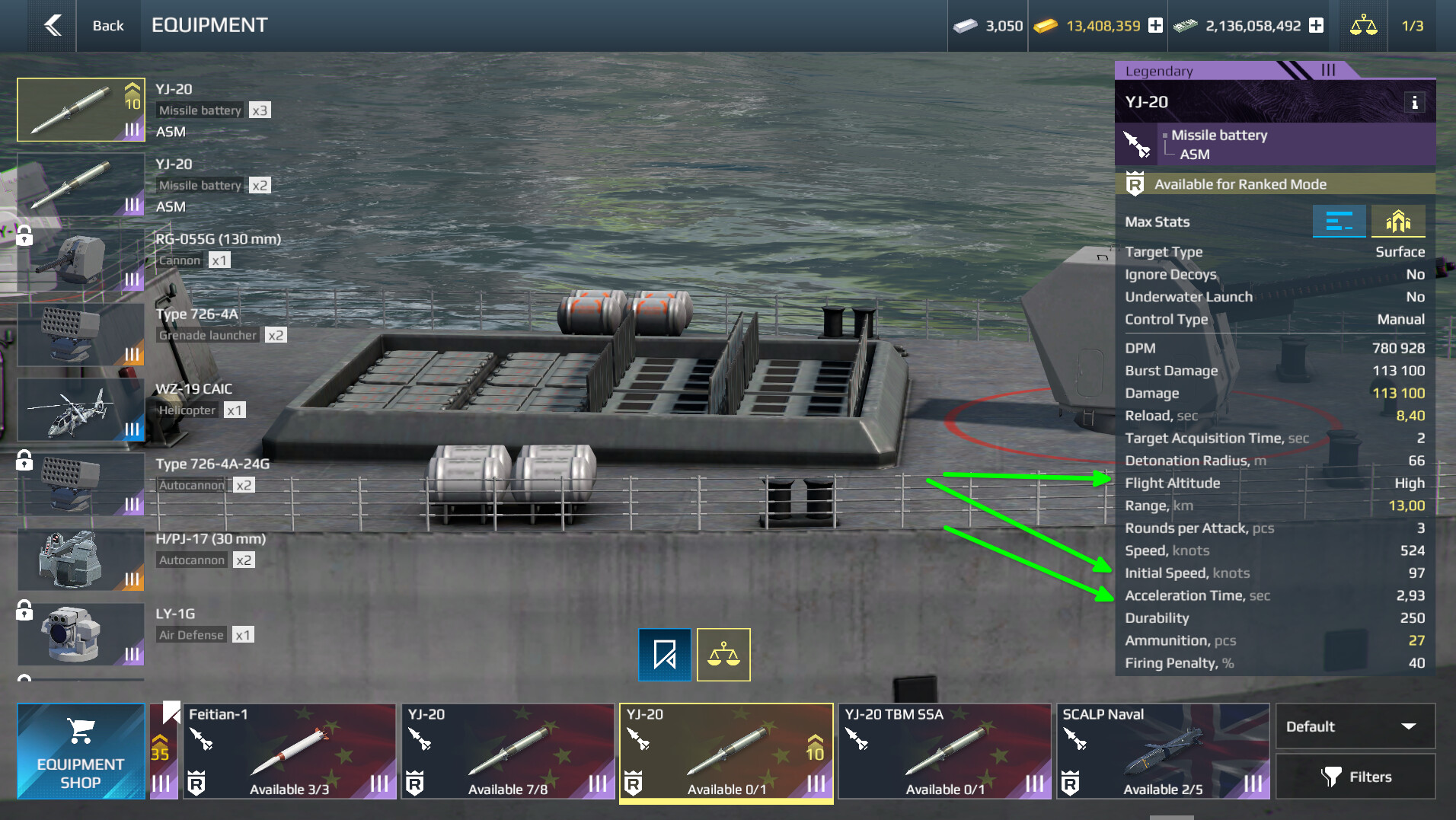
The underlying mechanic is simpler than it may seem: air defenses need to reach and engage an incoming threat. The lower and less exposed a projectile or missile is, and the faster it passes through the danger zone, the harder it is to intercept. The higher and more predictable its trajectory, the longer it remains under fire.
This rule primarily applies to missile-based air defense systems and, to some extent, gun-based air defenses. Laser air defense works somewhat differently: it is most effective against targets that have already come relatively close, while its effectiveness decreases as distance increases.
Not Everything Is Perfectly Balanced — and That Is Fine
Not every weapon represents a perfect trade-off between one characteristic and another. Some weapons are objectively stronger, for example because they belong to a higher tier or use a more advanced type of system.
However, even a powerful weapon does not guarantee results on its own. Its effectiveness still depends on:
- engagement range;
- ship positioning;
- direction of attack;
- use of cover;
- proper timing.
That is exactly what makes learning different weapons interesting. Searching for a single universal “best” option is not always worthwhile. It is much more important to understand the conditions a particular weapon was designed for and how to make the most of its strengths.
How to Evaluate a Weapon Before Equipping It
Here is a short checklist to go through before installing a weapon on your ship:
1. What is its obvious advantage? Damage, range, target types, reload time — what makes it stand out?
2. What does it probably sacrifice for that advantage? Low damage per shot, limited range, long reload time, slow initial acceleration, or an unfavorable trajectory?
Not every drawback is immediately visible from the raw stats, so final conclusions are best made after testing the weapon yourself.
3. Test the weapon at different ranges and against targets protected by air defenses. Practical testing can often tell you more than simply comparing stats in the equipment menu.
4. Consider its trajectory and launch characteristics. Against strong air defenses, a fast-starting, low-flying threat is generally more reliable. Against targets with weak air defenses, damage and range become more important.
Because of their trajectory, some missiles may fail to hit an enemy at close range due to the combination of their initial speed and launch direction.
5. Does it suit the task you need it for? Against strong air defenses, fast acceleration, high durability, and minimal time spent within the interception zone are especially important.
Against lightly defended targets, you can prioritize high damage or long range.
If a weapon has no obvious weakness, its effectiveness will depend more heavily on positioning, direction of attack, and choosing the right moment to use it.
Key Takeaway
Weapons in Modern Warships should not be evaluated based on a single impressive stat, but rather on the combination of their characteristics. Damage and range matter, but trajectory, acceleration, reload time, and the ability to penetrate air defenses can often have a much greater impact on actual performance.
The better you understand the strengths and limitations of each weapon, the easier it becomes to choose the right equipment for your ship, your opponent, and your own playstyle.